To coin a phrase from the 1970s: "And now for something completely different". This is from Peter Pig's War of the Roses range. It's Pack 22: "Dead cart with a pile of dead bodies, horse, and a dead collector".


To coin a phrase from the 1970s: "And now for something completely different". This is from Peter Pig's War of the Roses range. It's Pack 22: "Dead cart with a pile of dead bodies, horse, and a dead collector".
Back in the mists of time I used to write my own web pages in a simple text editor then upload them to a web server by FTP. Later I graduated to a more complex editor and added CSS to my repertoire.
None of this was really required when I started blogging in 2007 with Blogger. However, I began to find Blogger's WYSIWYG editor increasingly difficult to control. I switched to editing the "raw" HTML to get a consistent look.
Until recently, I would write a blog item directly in Blogger's HTML editor. I only switched to the WYSIWYG view for spell checking and final proof reading.
At the beginning of this year I became increasingly frustrated with Blogger's HTML editor. Not because it's a bad editor, I actually really like it, but because it distracts me.
I get tied up with HTML tags rather than writing. To speed things up I have some keyboard shortcuts that add paragraph tags and the like. Despite this, writing was still slower than I'd like.
For bronze shields I use Vallejo Brass (70.801) thinned with water. Three or four thin coats produce the smooth, highly polished look I want.

Last weekend saw a sudden surge in wargamers leaving Twitter for the Bluesky social network. I wonder why?
Thanks to Henry Hyde creating a starter pack for Historical Miniatures Wargaming I have acquired nearly 150 new followers in 48 hours. Bluesky starter packs allow new members to follow up to 150 people with one click. It's a nice feature.
So I thought it was time to automate posting from my blogs to Bluesky via their RSS feeds. I have already done this for the Fediverse so I had some idea what was required.
Base edges: I always paint the edges of my bases before applying any groundwork as it gives a far neater finish. I usually use the first colour given in the recipe, although for my North American, temperate scheme I quite like black edges.
Groundwork:This comprises two layers of sand and PVA (white or wood glue). The first layer is fine sand; mainly to texture around and across the figure bases. The second is a layer of coarse sand to hide the figure bases. This basic groundwork doesn't need to be painted, just highlighted (see Temperate #2).
I succumbed to the "wargames butterfly" syndrome once again and placed a modest order with Ancient & Modern for a selection of Hellenistic figures from their "Originals" range.
The plan was threefold:
As you can see it was a coherent and well thought out purchase. Well maybe not: I should be concentrating on finishing my Later Macedonians and I have more than enough medium cavalry already.
The elephant was the main reason I placed the order. I've built their elephant models before and they turned out well. So despite my reservations about the amount of preparation involved, I placed my order.

Read on for more photos and my notes on the build and painting.
In October last year I cleaned my painting desk and re-organised my paints. When I'd finished I realised it was time to invest in a vertical paint rack as I was running out of space on my desk no matter how I arranged things.
I looked around online and ordered this from Warbases for £12.00 plus £2.60 postage:

This year I will be taking a Hellenistic army to the King in the North competition in October. As I've mentioned, I'll be using borrowed troops for the bulk of the army but to complete the list I will need to paint half a dozen units or so of Thracians.

We've all done it!. Bought something on impulse that is. In my case I bought the Arab Conquest Army Deal from Red Copper for a mere 30€. The deal includes both 15 & 28 mm versions.

I want to make it clear that I do not own a 3D printer nor do I intend to go down that route due to lack of space in my new home. This makes the purchase seem somewhat less than sensible, but I do think 3D printing is the way forward. Somehow, I managed to convince myself this would be a sensible medium term investment.
No. Not cutting your fingers with a scalpel or stabbing yourself on a pike. This is a bit more serious and a cautionary tale for all avid modellers and painters. Please bear with me as the background is important.
For some time I've been suffering with a problem with my left shoulder and the left side of my upper back. In 2019 it got a lot worse and I thought I'd injured myself in the gym. I had tingling fingers and pains in my left arm. My GP thought I might have something more serious so I had an MRI scan and was tested to see if I had Multiple Sclerosis.
Thankfully all the test were negative and I was referred for physiotherapy. A set of simple exercises eased, and then eliminated, most of the trouble with my back and tingling fingers. My shoulder still had the odd twinge but nothing too serious.
Lockdown came and went. I painted a lot; almost every day. The twinges persisted. I tried all sorts of stretches many of which helped but nothing really eliminated the problem.
This is one of my "hobby haul" from Phalanx last month. They are the first camels for my Arab Empire armies. Imagine an Arab army without any camels!
I wanted Essex figures as I usually find them a pleasant change of "painting pace" compared to Forged in Battle. Plus I have no intention of fielding large numbers of camel riders so buying a large pack from Forged in Battle wasn't really an option.

In the end I was glad only bought one pack. Usually, I find Essex figures quicker and easier to paint, but not this time.
Here's the latest addition to my Arab Conquest army for Art de la Guerre (ADLG). It is the penultimate group of infantry in my army.

This is a post showcasing the third, and final, infantry command base for my Tudor army at Bosworth. The base represents Sir Rhys ap Thomas of Dinefawr, his standard-bearer and livery captains using Donnington New Era figures.
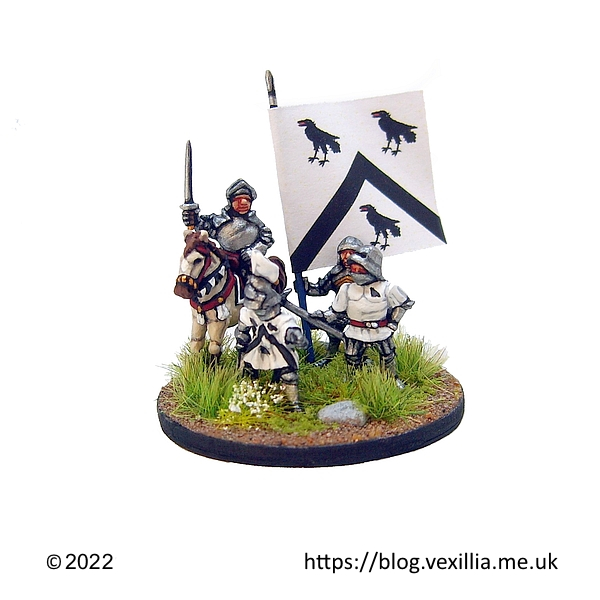
I already have a set of three mounted, and two foot commanders based for Art de la Guerre (ADLG) but I felt the need(?) for one more commander on foot. Any excuse to re-use the flags I created.
I'm quite some way off finishing my Arab Conquest army but even so there's pleasure to be had reading the various Arab Art de la Guerre (ADLG) lists and day dreaming about what the army will be like when it's finished.
During one such session I noticed the option to use medium spearmen with missile support (see the end section for what that means in ADLG) and after reading the rules I realised this would be a good thing.
Although not strictly necessary, I settled on using LI bases at the rear of the spear units to signify the missile support. On checking my pile of unpainted figures I realised I did not have enough figures for these markers and would have to buy more from Forged in Battle.
The extra pack duly arrived but as I sorted through them I spotted that one casting was prone to a fatal flaw.

And so it begins. New year: new army!
In choosing a new army I wanted something versatile and something outside my normal bailiwick of late medieval armies. After a bit of reading I decided on the Arab Conquest period (600 - 800 AD). This was partly because it would give me my first "Dark Age" army, allowing me to enter more competitions, and partly because the period offers lots of armies to chose from but all with a common core.

This post marks the completion of my late medieval (or Muscovite) Russian army. The three commanders below are put together from some left over figures and a pack of musicians.

Ever since I returned to wargaming in the 1990s I've used metal toolboxes to store and transport my finished armies.

Painting white horses is an important technique for every wargamer to master because we all know that throughout history all important leaders "always" rode a white horse.

In January this year I began using more and more craft paints. They have some clear advantages and a few disadvantages but, used with these in mind, they offer lots of useful results. Here's what I've found so far.


